Español



Content
- 1 Quick Answer: The 10 Specs That Decide a Vertical Solar PV Light Pole Order
- 1.1 Module geometry and face count
- 1.2 Module power and voltage
- 1.3 Battery capacity and autonomy
- 1.4 LED output and optics
- 1.5 Pole diameter and module length
- 1.6 Wind load at pole level
- 1.7 Dust, snow and cleaning
- 1.8 Controller and dimming logic
- 1.9 Materials and ingress protection
- 1.10 Folding and installation method
- 2 Vertical Solar Panel vs Flat Solar Panel Street Light: What Changes
- 3 Vertical Solar Street Light Efficiency: Cell, System and Daily Profile
- 4 Module Geometry: Quadrilateral, Hexagonal, Octagonal or Full-Circle
- 5 Module Power and Voltage: Size the Array to the Nightly Load
- 6 Battery Capacity and Autonomy: Store Enough for the Longest Night
- 7 LED Luminaire, Optics and Dimming Logic
- 8 Pole Diameter and Module Length: Confirm the Fit First
- 9 Vertical Solar Light Pole Wind Resistance: Reading the Numbers
- 10 Dust, Snow and Cleaning: Why Vertical Faces Stay Cleaner
- 11 Materials, Coating and Weather Protection
- 12 Foldable Design, Packaging and Installation
- 13 Foldable Vertical PV Modules to Shortlist
- 14 Vertical Solar Light Pole for Park, Campus, Resort and Pedestrian Street
- 15 Cylindrical Solar Panel Street Light: Pros and Cons
- 16 Choosing a Vertical Solar PV Light Pole Manufacturer, Supplier or OEM Partner
- 17 Pre-Order Checklist for Contractors and Project Managers
- 18 Sources and Method Notes
- 19 Vertical Solar PV Light Pole FAQ
- 19.1 Q1. What is a vertical solar PV light pole?
- 19.2 Q2. How does a vertical solar light pole work?
- 19.3 Q3. Are vertical solar panels as efficient as tilted solar panels?
- 19.4 Q4. Do vertical solar light poles work in cloudy weather or winter?
- 19.5 Q5. Can I retrofit an existing light pole with vertical solar modules?
- 19.6 Q6. What pole diameter is compatible with vertical solar PV modules?
- 19.7 Q7. Where is the battery located in a vertical solar light pole?
- 19.8 Q8. How does a vertical solar pole handle strong wind?
- 19.9 Q9. Do vertical solar poles need cleaning?
- 19.10 Q10. How long do vertical solar light poles last?
Quick Answer: The 10 Specs That Decide a Vertical Solar PV Light Pole Order
A Vertical Solar PV Light Pole works well on site when ten specs agree with each other: module geometry, module power and voltage, battery capacity, LED output and optics, pole diameter, pole-level wind load, dust and snow behavior, controller and dimming logic, materials and ingress protection, and the folding and installation method. When one of them is left open, the rest of the design has to guess. The cards below give the short version of each spec, and the sections after them explain how to check it.
Module geometry and face count
Quadrilateral, hexagonal, octagonal or full-circle housing changes how evenly the pole collects light from every direction.
Module power and voltage
Match rated watts and the 18V or 36V option to the nightly load and the controller input.
Battery capacity and autonomy
Size usable watt-hours for the longest night plus the cloudy days you expect in the worst month.
LED output and optics
Confirm lumens, light distribution and color temperature for the mounting height and the path width.
Pole diameter and module length
The module wraps the pole, so outer diameter at the mounting height is the first fit check.
Wind load at pole level
Module load ratings are one input. The pole, base and anchor still need a project-level calculation.
Dust, snow and cleaning
Steep faces shed deposits more readily, but the site still needs a simple inspection routine.
Controller and dimming logic
Charge control type, dimming stages and motion response decide how far the stored energy stretches.
Materials and ingress protection
Glass, frame alloy, connectors, coating and the ingress rating should suit rain, dust and salt exposure.
Folding and installation method
Flat-pack shipping and on-site unfolding change freight volume and crew time.
Most of these specs lead back to one question: does the energy collected in the weakest month cover the energy the lamp uses on the longest night? Product figures in this guide come from the Foldable Vertical PV listings on the Forland website. Geometric figures are calculated by the author, and any value that is an assumption for illustration is labeled as one in its caption.
Vertical Solar Panel vs Flat Solar Panel Street Light: What Changes
A flat panel street light carries a rectangular panel on top of the pole or on an arm, tilted toward the equator. It collects the most light when the sun is in front of it and loses output as the sun moves away from that facing direction. A wrap-around vertical module takes a different route. The photovoltaic faces surround the pole, so some part of the module looks toward the sun from sunrise to sunset. The manufacturer describes the result as at least half of the surface being oriented toward the sun at any time, which matches simple geometry: half of the outer surface of any convex shape faces a given direction of light.
That difference leads to design trade-offs rather than a simple winner. The table sets the two layouts side by side so that you can see which trade-offs matter for your site.
| Feature | Flat tilted panel | Wrap-around vertical module |
|---|---|---|
| Facing direction | One fixed direction | All directions around the pole |
| Wind profile | Wide flat face at the top of the pole | Slim round or polygonal profile along the pole |
| Dust and snow | Deposits can rest on low-angle glass | Steep faces shed deposits more readily |
| Output per cell area | High while the sun is in front | Lower, because about half the cell area faces away from the sun |
| Visual profile | Panel visible above or beside the pole | Module reads as part of the pole |
| Shipping | Rigid flat panels | Folds flat, over 50% less packaging volume on listed models |
Reading the comparison as a planner
If the pole stands in an open field with a clear view to the equator and the lamp has a high nightly load, a tilted panel gives more output per square meter of cell. If the pole stands in a park, on a campus mall or along a pedestrian street where the sun direction changes with trees and buildings, a wrap-around module keeps collecting from whichever side has light. The radar chart below summarizes the trade-off on six planning criteria.
Where the footprint score comes from
A tilted panel on an arm adds a lever and a wide surface to the pole top, and it needs a clear zone around it. A wrap-around module sits inside the pole outline, so it adds no arm and no extra ground area. That matters on narrow walkways, in courtyards and along building fronts where a protruding panel would collide with trees, signs or pedestrians.
Vertical Solar Street Light Efficiency: Cell, System and Daily Profile
Efficiency questions about a vertical layout get mixed answers because three different things share the same word. Cell efficiency describes how much sunlight a cell converts. The octagonal module listing on the Forland site states monocrystalline cells at 23.20% efficiency. System efficiency covers wiring, controller conversion, battery round-trip loss and temperature effects, and sizing worksheets commonly assume a value near 0.70 for the chain from module to lamp. Geometric yield describes how much of the available sunlight lands on cells at each hour, and this is where the wrap-around layout differs most from a flat panel.
How a cylinder collects light through the day
The chart below applies a simple clear-sky beam model to three surfaces of equal projected width at 35 degrees north latitude on an equinox day. The cylinder presents the same sun-facing width at every azimuth, so its curve is smooth. A single flat face aimed south peaks at noon and fades toward morning and evening. A single flat face aimed east collects only before noon. The model applies the air-mass attenuation formula 0.7 raised to the power of air mass to the 0.678 (the Meinel relation described in Duffie and Beckman, Solar Engineering of Thermal Processes), which reduces the gain from a low sun.
Two points stand out. First, the cylinder curve is higher in the morning and evening than at noon because a low sun is closer to perpendicular to a vertical surface. Light at those hours passes through more atmosphere, which the model reduces but does not remove, so real-world output at the edges of the day will be lower than a simple geometric reading suggests. Second, the flat south face matches the cylinder only at noon. Add up the whole day and the picture is clear.
| Surface | Daily index |
|---|---|
| Cylinder or full-circle wrap | 100 |
| Flat vertical face aimed south | 55 |
| Flat vertical face aimed east | 37 |
| Flat vertical face aimed west | 37 |
| Flat vertical face aimed north | 0 |
The honest trade-off: for any convex wrap, the total cell area equals pi times the average projected width. So the wrap uses about 3.1 times the cell area of a single flat face of the same width, and in this model a south-facing flat face collects more per square meter of cell. The wrap gives up some output per cell area in return for direction independence, a smaller wind profile and no arm. Treat that as a design choice, not a defect.
Cloudy days and low winter sun
Under cloud, most light arrives as diffuse sky light. In the isotropic sky model by Liu and Jordan, a vertical surface sees half of the sky dome, which is half the diffuse view of a horizontal surface. Light reflected from the ground, which can rise noticeably over snow, adds to that. In winter at mid and high latitudes, the sun sits low, and a vertical face is closer to perpendicular to it than a horizontal one. These effects explain why vertical layouts are often considered for sites with winter loads, but they do not remove the need to size the battery for several low-output days.
Check your own site with free data
The NREL PVWatts Calculator lets you enter a tilt angle up to 90 degrees and an azimuth, so you can compare a vertical face with a tilted one for your location. The Global Solar Atlas, published by the World Bank Group with Solargis, offers irradiation maps for planning. Use the lowest monthly values, not the annual average, when the lamp must run every night.
Module Geometry: Quadrilateral, Hexagonal, Octagonal or Full-Circle
The first spec on the list sets how smoothly the pole collects light as the sun moves. The Forland Foldable Vertical PV lineup offers four housing geometries: quadrilateral, hexagonal, octagonal and full-circle. More faces make the sun-facing width more uniform at every azimuth. Fewer faces make each panel larger and simpler to produce, and a four-sided housing gives a strong architectural line.
The table gives the geometry numbers for regular shapes that share the same circumscribed diameter. The average sun-facing width follows Cauchy's projection result, in which the mean projected width of a convex shape equals its perimeter divided by pi.
| Housing | Faces | Average width | Lowest width |
|---|---|---|---|
| Quadrilateral | 4 | 90.0% | 70.7% |
| Hexagonal | 6 | 95.5% | 86.6% |
| Octagonal | 8 | 97.5% | 92.4% |
| Full-circle | Curved | 100% | 100% |
How to choose a shape
- Quadrilateral suits compact poles and small loads such as garden columns and smart poles. The lowest-width direction is the diagonal gap, so check the yield when the sun sits at a face angle.
- Hexagonal gives a more even profile and suits mid-range loads on lighting poles and infrastructure columns.
- Octagonal comes close to a cylinder and suits larger poles, urban lighting and masts with higher loads.
- Full-circle gives the same width in every direction and the cleanest look on decorative poles.
Ask the supplier which face count is available at your pole diameter and module length, because the geometry options and the length options combine into a smaller set than the full catalog.
Module Power and Voltage: Size the Array to the Nightly Load
The Forland lineup spans 76W to 320W. The chart plots the rated power of eight modules that appear on the Foldable Vertical PV product listing. Small quadrilateral modules at 76W and 100W suit compact loads. Octagonal modules at 152W and 240W serve higher-load poles and masts.
A worked sizing example
Start with the lamp. Multiply lamp power by operating hours to get nightly energy, divide by the effective sun hours on the vertical faces in the weakest month, then divide by system efficiency. The result is the module rating you need at minimum.
Module watts = nightly watt-hours / (effective sun hours x system efficiency)
| Item | Value | Basis |
|---|---|---|
| Lamp power | 40 W | Assumed |
| Operating time | 10 hours | Assumed |
| Nightly energy | 400 Wh | 40 x 10 |
| Effective sun hours, weak month | 3.0 hours | Assumed for vertical faces |
| System efficiency | 0.70 | Assumed |
| Minimum module rating | About 190 W | 400 / (3.0 x 0.70) |
In this example the next listed rating above 190W is the 240W octagonal module, which leaves headroom for dust, aging and a few weak days. A load that small might also be served by a lower-rated module if the site has stronger winter sun, so run the numbers with local data before choosing.
Voltage and controller match
The listed octagonal modules offer 18V and 36V dual voltage options, and they use standard 2.5mm MC4 connectors. Confirm that the controller input range accepts the module voltage you select, and ask whether the controller uses PWM or MPPT charging. MPPT controllers can harvest more energy when the module voltage and the battery voltage are far apart, which is common with a 36V module and a 12.8V battery bank.
Battery Capacity and Autonomy: Store Enough for the Longest Night
The battery turns daytime collection into night lighting. Its usable capacity, its chemistry and its location in the pole system decide how many nights the lamp can run without sun. The chain below shows where the battery sits in a typical vertical solar PV light pole.
Autonomy and depth of discharge
Many project specifications ask for two to three nights of autonomy, meaning the stored energy covers that many nights with no charging. Battery makers limit how deeply the pack should be discharged, so usable capacity is smaller than nominal capacity. Lithium iron phosphate (LiFePO4) is a common chemistry in solar street lighting because it tolerates frequent cycling, and many designs limit discharge to around 80% of nominal capacity.
| Step | Result |
|---|---|
| Three nights of autonomy | 1200 Wh usable |
| Divide by 0.80 discharge limit | 1500 Wh nominal |
| At 12.8 V system voltage | About 117 Ah |
| At 25.6 V system voltage | About 59 Ah |
Where the battery sits
A wrap-around module leaves the pole body free for other components, but the battery location varies by design. It may sit inside the pole, in a compartment mounted on the pole, in a base cabinet, or in a separate box. Each option changes the cable run, the heat exposure and the service access. Ask for a drawing that shows the battery position, the cable path from the module to the controller and the access hatch size. Also check the battery operating temperature range against the site climate, because the module listing states minus 20 to 70 degrees C for the module itself, and the battery pack has its own limits.
LED Luminaire, Optics and Dimming Logic
A vertical module can cover the energy supply, yet a poor light distribution leaves paths dark and wastes stored energy. Four items belong on the luminaire spec sheet.
- Luminous flux and efficacy. Lumens set the light level, and lumens per watt set how far the battery stretches. A higher efficacy lets the same module and battery support more light.
- Light distribution. A wide, shallow distribution suits a footpath. A longer, narrower pattern suits a road. Request the photometric file for your mounting height and spacing.
- Color temperature. Warm white in the 2700K to 3000K range is common at resorts and pedestrian streets, while neutral white around 4000K is common on campus roads and car parks.
- Glare control. Shielding and mounting height affect comfort for people walking underneath.
Dimming and sensing
A typical profile runs the lamp at full output for the first hours of the evening, drops to a reduced level after the foot traffic fades, and returns to higher output before dawn. A motion sensor can raise the output when someone approaches. Each stage changes the energy budget, so the sizing example above must use the average load across the profile, not just the peak wattage. Ask the supplier to show the dimming stages in the controller settings and confirm whether they can be edited after installation.
Practical tip: run the sizing twice, once with the full-power load and once with the dimmed profile. The gap between the two results shows how much the controller program adds to the system.
Pole Diameter and Module Length: Confirm the Fit First
Because the module surrounds the pole, the outer diameter at the mounting height is the first geometric check. The Forland listings state maximum pole diameters of 170mm for the Foldable Lighting Pole Solar Panel, 255mm for the Octagonal Lighting Pole Solar Panel and the Foldable Surveillance Mast Solar Panel, and 370mm for the Octagonal Surveillance Mast Solar Panel.
Measurements to take before ordering
- Outer diameter at the lower and upper edges of the planned mounting zone, since many poles taper.
- Height of the clear zone between the base flange and the luminaire arm.
- Position of welds, access doors, cable glands and any existing brackets that the module must clear.
- Wall thickness and material of the pole, so the clamping method does not deform it.
- Distance from the module bottom to the ground or the nearest walking surface, for safety and for vandal resistance.
Listings give a maximum diameter, so ask the supplier for the minimum diameter and the clamp range too. A module sized for a 255mm pole is not automatically right for a 100mm pole.
Vertical Solar Light Pole Wind Resistance: Reading the Numbers
Wind is the load most often raised in questions about a pole that carries a large module. The manufacturer states that the vertical configuration lowers wind load compared with a flat panel of similar power output. That is consistent with the geometry, since a slim round or polygonal body spreads the load around the pole instead of presenting a wide face to the gust. It still needs a number for your site.
Dynamic pressure at common wind speeds
Dynamic pressure is half of air density times speed squared. The table uses standard air density of 1.225 kg per cubic meter. The values are before shape, height and gust factors, so they show scale, not a design load.
| Wind speed | In km/h | Dynamic pressure |
|---|---|---|
| 20 m/s | 72 | 245 Pa |
| 30 m/s | 108 | 551 Pa |
| 40 m/s | 144 | 980 Pa |
| 50 m/s | 180 | 1531 Pa |
The octagonal module listings state a mechanical load capacity of 5400 Pa on the front and 2400 Pa on the back. Those figures describe the module as a component. They do not describe the pole.
Questions for the pole-level check
- What design wind speed and exposure category was used for the pole and base?
- Does the calculation include the projected area and weight of the wrap-around module at its mounting height?
- What base moment does the anchor bolt pattern or foundation need to resist?
- Has the sway of a tall, slender round section in steady crosswind been considered, and is any damping used?
- How are the module clamps fastened, and how do they handle thermal movement of the aluminum frame?
Dust, Snow and Cleaning: Why Vertical Faces Stay Cleaner
Dust, pollen and light snow settle on surfaces that are close to horizontal. A vertical face is a poor resting place for them, and rain or melting snow run down the glass rather than pooling on it. The manufacturer describes this as natural shedding of dust and snow that reduces surface buildup. In practice, this means cleaning intervals can be longer than for a flat panel at low tilt, but it does not mean zero cleaning.
Helps the vertical layout
- Rain runs off steep glass
- Snow slides off or does not accumulate on faces
- Less leaf and debris pile on glass
Still needs attention
- Road dust and salt film near highways
- Bird droppings near the top edge
- Sprinkler spray with mineral content
A simple inspection routine
Check the glass during scheduled lighting inspections. If a film is visible, rinse with clean water and wipe with a soft cloth. Avoid abrasive pads and strong solvents because they can scratch the glass surface or damage the frame finish. Where sprinklers wet the pole, adjust the heads so the module is not sprayed, since mineral water leaves marks as it dries. After storms, look at the clamps and the connector area for loose hardware.
Materials, Coating and Weather Protection
A pole outdoors faces rain, UV, dust, temperature swings and sometimes salt. The listings for the octagonal modules describe monocrystalline silicon cells under high-strength tempered glass in an aluminum frame, with an IP66 ingress rating, an operating range of minus 20 to 70 degrees C and a power tolerance of plus or minus 3 percent. Standard 2.5mm MC4 connectors handle the wiring.
Use these points to compare offers on the same footing.
- Glass and frame: tempered glass thickness, frame alloy and anodized or powder-coated finish.
- Fasteners: stainless steel hardware at clamps and hinges, particularly near the coast.
- Connectors and cables: MC4 type connectors, UV-resistant cable jackets and drip loops where cables leave the module.
- Pole coating: galvanizing and paint system, with extra attention where salt spray or industrial air is present.
- Temperature range: compare the module range with the battery and driver ranges for the coldest and hottest months.
Forland runs die-casting machines, CNC machines, punching machines and automatic spraying and assembly lines at its factory in Ninghai, Ningbo, which lets frames, housings and finishing be handled in-house from raw material to finished product. When you compare suppliers, ask which parts are made in-house and which are bought in.
Foldable Design, Packaging and Installation
Foldable Vertical PV modules fold flat for shipping, which the manufacturer states reduces packaging volume by more than 50 percent. On site they unfold and lock into a multi-sided vertical cylinder around the pole. The practical gains show up in container loading, in handling at the job site and in the number of people needed to place the module on the pole.
Structure at a glance
The isometric drawing shows the main parts of a wrap-around vertical solar PV light pole: the LED luminaire on an arm, the mounting pole, the hexagonal photovoltaic wrap, a battery compartment and the base with its anchor.
On-site sequence
- Clean the pole surface at the mounting zone and mark the module height.
- Lift the folded module into position and unfold it around the pole.
- Close and lock the seam, then fasten the clamps to the pole.
- Route the MC4 leads into the controller path with a drip loop.
- Connect the battery and the luminaire, then check charge and lamp function in daylight and at dusk.
Ask the supplier for an installation drawing and a wiring diagram with the order, so the crew can prepare tools and lifting equipment before the delivery arrives.
Foldable Vertical PV Modules to Shortlist
The cards below show modules from the Foldable Vertical PV category. Each card lists data that appears on the manufacturer's product page, so you can match pole diameter and power before contacting the factory.
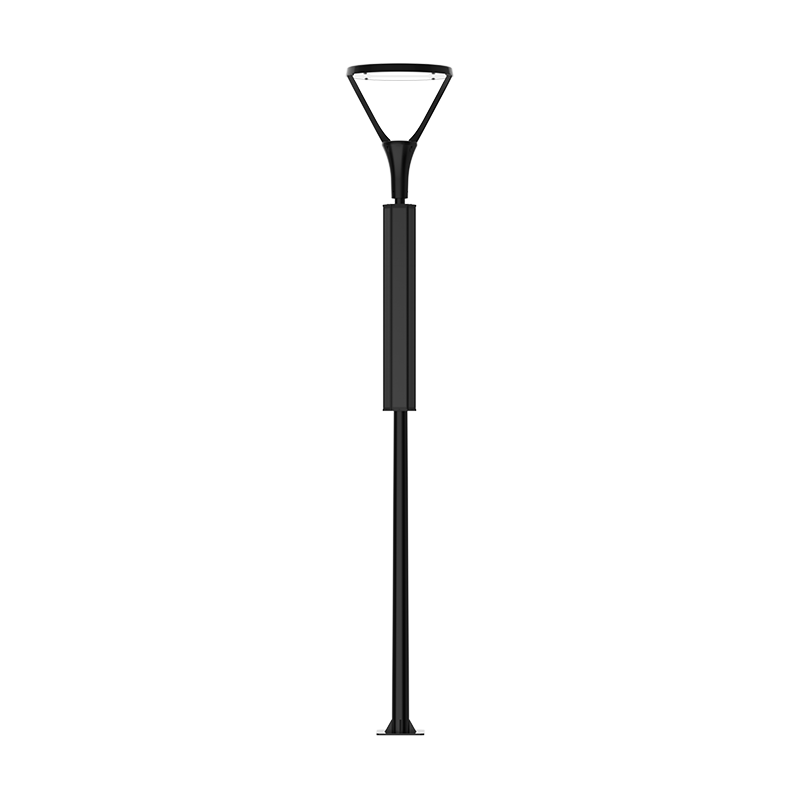
Foldable Lighting Pole Solar Panel
- Unfolds into a vertical cylinder around the pole
- Poles up to 170mm in diameter
- Monocrystalline cells, 18V and 36V options
- Packaging volume reduced by over 50%
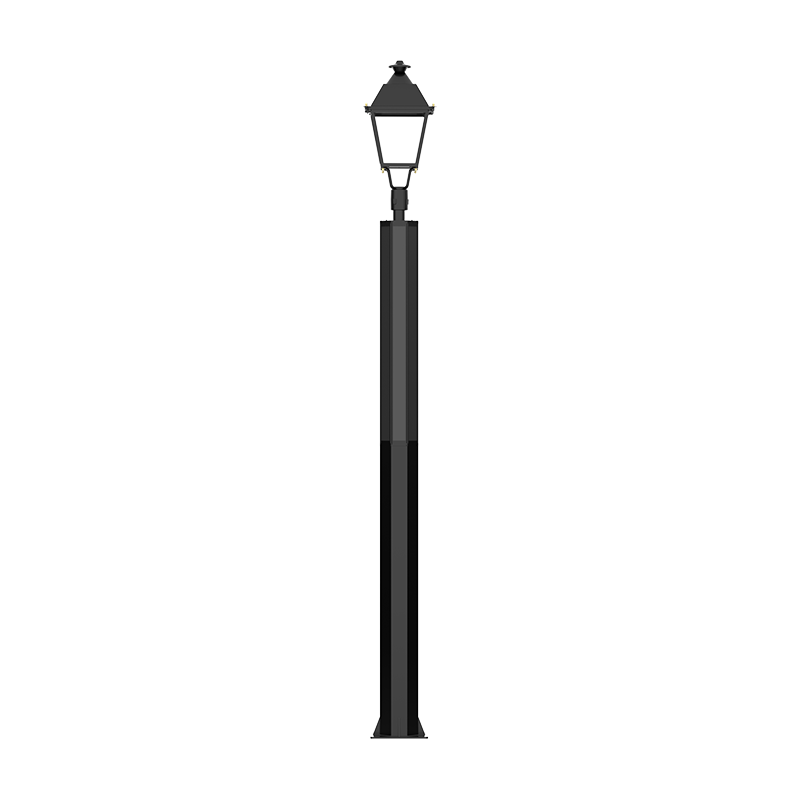
Octagonal Lighting Pole Solar Panel
- 152W peak power, 23.20% cell efficiency
- Poles up to 255mm in diameter
- IP66 rating, minus 20 to 70 degrees C
- Tempered glass, aluminum frame, MC4 connectors
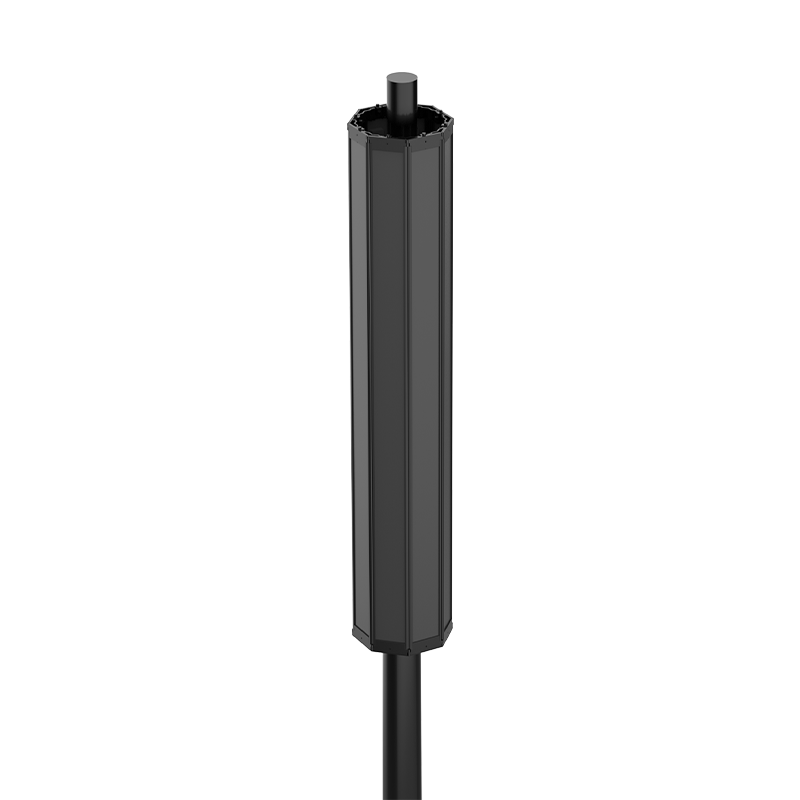
Industrial Foldable Solar Panel for Heavy Masts
- Octagonal module for large-diameter masts
- Suited to telecom towers and major roadway lighting
- Selectable voltage output
- Reinforced glass and heavy-duty aluminum frame
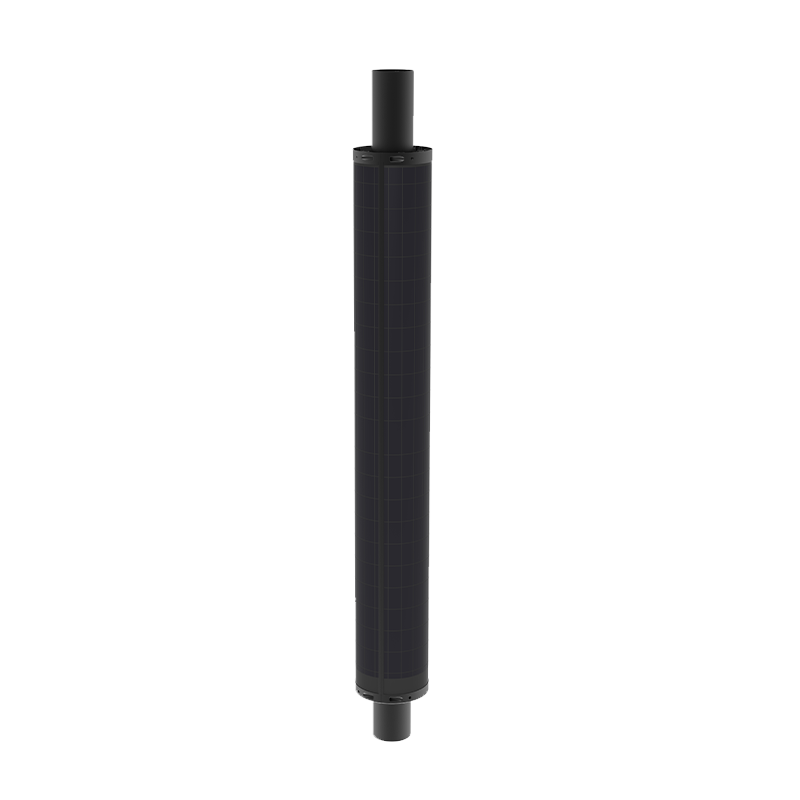
Foldable Vertical PV Series
- Quadrilateral, hexagonal, octagonal and full-circle housings
- Two module lengths, 76W to 320W
- For lamp poles, CCTV masts, traffic signal posts and towers
- Custom options available on request
Vertical Solar Light Pole for Park, Campus, Resort and Pedestrian Street
A vertical solar light pole for park, campus, resort and pedestrian street use shares a common need: lighting that works in places where trenching for cable is difficult or disruptive, and where the pole should look clean and compact. The tiles below describe what to check at each type of site.
Park paths
Tree shade changes by season, so a module that collects from all directions reduces the effect of one blocked side. Choose a warm color temperature and a wide, low distribution to protect the night sky and the planted areas.
Campus walkways
Buildings cast moving shadows across paths. Check mounting height against sightlines and ask for dimming profiles that follow class and event schedules.
Resort grounds
Appearance matters as much as output. A hexagonal or full-circle housing blends with garden design, and a corrosion-resistant finish handles coastal air and irrigation moisture.
Pedestrian streets
Narrow streets leave no room for a protruding panel. A wrap-around module keeps the pole slim, and a motion sensor can raise light levels when people pass.
Decorative solar light pole for commercial walkway
Shopping lanes, hotel entrances and mixed-use plazas often need a decorative solar light pole for commercial walkway lighting, where the design language of the pole is part of the brand of the space. A wrap-around module can be integrated into the visual rhythm of the pole, with the module length chosen to match the pole proportions. Discuss color finish, face count and the module length with the supplier early, because these decide how the pole looks from a distance and at eye level. Check light distribution so the building fronts and the walking surface receive balanced light without glare toward upper floors.
Cylindrical Solar Panel Street Light: Pros and Cons
A balanced review of a cylindrical solar panel street light lists strengths and limits side by side. The two blocks below summarize what the geometry, the manufacturer's data and the calculations in this guide point to.
Pros
- Collects light from every direction, so no aiming is needed during installation
- Slim profile reduces wind load compared with a flat panel of similar power, per the manufacturer
- Steep faces shed dust and snow more readily
- No arm or tilt frame, so the pole footprint stays small
- Folds flat for shipping, with over 50% less packaging volume
- Can retrofit onto an existing pole when diameter and strength allow
Cons
- About half of the cell area faces away from the sun at any moment, so output per cell area is lower than a single sun-facing panel
- Module weight and projected area add load to the pole and base
- Summer midday yield on vertical faces is lower than on tilted panels at many latitudes
- Pole diameter must fall within the module range
- Battery and cable layout need planning because the module wraps the pole body
Where the site has a clear sun path and the load is large, a tilted array may suit better. Where sun direction varies, space is tight or wind is a concern, a wrap-around module deserves a closer look.
Choosing a Vertical Solar PV Light Pole Manufacturer, Supplier or OEM Partner
A clear data sheet is only part of an order. The partner also needs to explain the module, supply drawings and keep the batch consistent. Forland, founded in 2008 and based in Ninghai, Ningbo, Zhejiang, China, positions itself as a professional vertical solar PV light pole manufacturer and Foldable Vertical PV pole factory, with more than 18 years in the lighting industry and work in research and development, design and production of LED lighting products.
Vertical solar light pole supplier for contractors
A vertical solar light pole supplier for contractors should support the whole job cycle, not just the shipment. Useful support includes drawings that match the site pole, a packing list that matches the installation sequence, wiring diagrams, spare connectors and clamps, and a clear contact for site questions. For a multi-pole project, ask for consistent module batches and labeled cartons per pole position, so the crew can work in order.
Custom vertical solar light pole OEM
A custom vertical solar light pole OEM project begins from a base module and changes the parts that matter to the buyer. Typical items to discuss are housing geometry, module length, power rating, voltage option, connector type, cable exit position, frame color, logo placement and carton marking. Request a sample for fit and function checks before a larger batch, and agree on the drawing set that will govern later orders.
| Item to send | Why it matters |
|---|---|
| Site latitude and city | Sets sun hours for the weakest month |
| Pole height, diameter and material | Decides module fit and clamp type |
| Lamp power and nightly hours | Sets module watts and battery size |
| Design wind speed | Feeds the pole-level load check |
| Climate and coastal exposure | Guides coating and fastener choice |
| Number of poles and delivery site | Plans packing and shipping |
Pre-Order Checklist for Contractors and Project Managers
Use this list as a last pass before issuing a purchase order. Each line maps back to one of the ten specs in this guide.
- Module geometry and length are confirmed against the pole drawing.
- Module rated power and voltage are matched to the sizing worksheet and the controller input.
- Battery usable capacity covers the planned autonomy for the weakest month.
- Luminaire lumens, distribution and color temperature match the path or road layout.
- Pole outer diameter at the mounting zone is inside the module range.
- Pole, base and anchor have a written wind load calculation that includes the module.
- A cleaning and inspection routine is agreed with the site owner.
- Dimming stages and sensor settings are listed on the controller data sheet.
- Materials, coating and ingress rating suit the local climate.
- Installation drawing, wiring diagram and packing list are supplied with the shipment.
When every line has an answer from the supplier in writing, the order can move forward with a clearer view of how the pole will behave in service.
Sources and Method Notes
- Product figures: Forland Foldable Vertical PV product category and model pages on forlandlighting.com.
- Air-mass attenuation relation: Duffie and Beckman, Solar Engineering of Thermal Processes.
- Isotropic sky diffuse model: Liu and Jordan, 1963.
- Solar resource tools: NREL PVWatts Calculator and the Global Solar Atlas by the World Bank Group and Solargis.
- Geometry, line chart and wind pressure values: calculated by the author from the stated formulas and assumptions.
- Radar scores and sizing examples: illustrative planning values, not measurements.
Vertical Solar PV Light Pole FAQ
Q1. What is a vertical solar PV light pole?
It is a lighting pole where photovoltaic faces wrap around the pole body as a vertical cylinder or prism, instead of a flat panel on top. The pole also carries an LED luminaire, a controller and a battery.
Q2. How does a vertical solar light pole work?
During the day the PV faces send power through the controller to the battery. At dusk the controller switches the LED on and draws from the battery, then follows the dimming profile until dawn.
Q3. Are vertical solar panels as efficient as tilted solar panels?
Per square meter of cell, a single panel facing the sun collects more. A wrap-around module collects from every direction through the day, so the comparison depends on the site, the load and the wind and space limits.
Q4. Do vertical solar light poles work in cloudy weather or winter?
They charge from diffuse light and from a low winter sun, which sits closer to perpendicular to vertical faces. Output drops on heavy cloud like any PV system, so size the battery for several low-output days.
Q5. Can I retrofit an existing light pole with vertical solar modules?
Often yes, when the pole diameter is in the module range, the clear height is available and the pole and base can take the added load. Ask the supplier for a fit check with your pole drawing.
Q6. What pole diameter is compatible with vertical solar PV modules?
The Forland listings state maximum diameters of 170mm, 255mm and 370mm depending on the model. Confirm the minimum and the clamp range too.
Q7. Where is the battery located in a vertical solar light pole?
It depends on the design. Common positions are inside the pole, in a compartment on the pole, in a base cabinet or in a separate box. Ask for a drawing that shows the position and the service access.
Q8. How does a vertical solar pole handle strong wind?
The slim profile presents less frontal area than a flat panel of similar power, according to the manufacturer. The pole, base and anchor still need a project wind load calculation that includes the module.
Q9. Do vertical solar poles need cleaning?
Less often than low-tilt panels, because steep faces shed dust and snow. Inspect the glass during routine checks and rinse with clean water and a soft cloth when a film builds up.
Q10. How long do vertical solar light poles last?
Lifetime depends on the parts. The octagonal module listing states a service life of over 20 years for the module, while batteries and drivers usually set shorter replacement intervals based on cycles, heat and use.