Español



Content
- 1 What Are Garden Post Lights? A Direct Answer
- 2 Garden Post Lights, Landscape Post Lights and Outdoor Garden Post Lights: Same Family, Different Wording
- 3 Main Types of Garden Post Lights and When Each One Fits
- 4 Anatomy of a Garden Post Light
- 5 Mounting Height and Spacing: How Much Light Reaches the Path
- 6 LED Light Source, Color Temperature and Glare Control
- 7 Energy Use and Dimming for Outdoor Garden Post Lights
- 8 Materials, Coatings and Weather Protection
- 9 Garden Post Lights From the Forland Range
- 10 Where Landscape Post Lights Fit Well
- 11 How to Choose Garden Post Lights: A Three-Step Method
- 12 Installation Planning and Maintenance Routine
- 13 Working With a Garden Post Lights Manufacturer for Custom Landscape Post Lights
- 14 Common Mistakes When Specifying Garden Post Lights
- 15 Sources and Method Notes
- 16 Garden Post Lights FAQ
- 16.1 Q1. What are garden post lights?
- 16.2 Q2. What is the difference between garden post lights and bollard lights?
- 16.3 Q3. What height should outdoor garden post lights be?
- 16.4 Q4. How far apart should landscape post lights be?
- 16.5 Q5. What color temperature suits garden post lights?
- 16.6 Q6. What does IP65 mean on a garden light?
- 16.7 Q7. Can garden post lights be used near the coast?
- 16.8 Q8. Can I customize landscape post lights?
- 16.9 Q9. How are garden post lights serviced?
- 16.10 Q10. Do garden post lights need dimming or sensors?
What Are Garden Post Lights? A Direct Answer
Garden Post Lights are outdoor luminaires mounted on a post, a short pole or a base at roughly pedestrian scale. They light garden paths, courtyards, plazas, building entrances and planted areas after dark, and they add to the look of the landscape during the day. Current models mostly use LED light sources inside a die-cast aluminum body with a sealed housing. Landscape Post Lights and Outdoor Garden Post Lights are used as near-synonyms in the trade. The difference lies in project wording and scale, not in a separate product design.
This guide explains what these fixtures are made of, which types exist, how mounting height and spacing change the light on the ground, and what to check before you choose a style. Product details come from the Garden Post Lights listings on the Forland website. Calculated figures are the author's own, and each caption states the assumptions.
What they do
Provide soft, even light for walking areas and give the landscape a defined evening look.
Where they stand
Along paths, at plaza edges, beside entrances and inside planted areas, usually at head height or above.
Light source
LED modules with lenses or diffusers, driven by a constant-current driver.
Body
Die-cast aluminum with a powder coat or electrostatic spray finish for outdoor use.
Weather protection
An IP65 rating is stated on two of the three Forland models listed in this guide.
Options
Pole height, luminaire shape, power configuration, color temperature and finish color can be customized.
Garden Post Lights, Landscape Post Lights and Outdoor Garden Post Lights: Same Family, Different Wording
Buyers meet three phrases for nearly the same product group. A homeowner searching for lights for a front path tends to type garden post lights. A designer working on a hotel garden or a park tends to write landscape post lights. A contractor ordering for a residential community may write outdoor garden post lights to separate them from indoor decorative lamps. The table shows how the terms are commonly used.
| Term | Common meaning | Typical setting |
|---|---|---|
| Garden Post Lights | Post-mounted fixtures for paths and yards | Homes, villas, small gardens |
| Landscape Post Lights | Post fixtures chosen as part of a landscape design | Parks, resorts, commercial grounds |
| Outdoor Garden Post Lights | Weather-sealed post fixtures made for exterior use | Communities and public paths |
What sets post lights apart from other outdoor lights
A post light carries its luminaire at the top of a post, so the light comes from above and spreads over a wider zone than a light at ground level. A bollard stands lower and sends light toward the walking surface. A floodlight is aimed at a target such as a tree or a wall. A wall light is fixed to a building. Garden post lights sit in the middle of that range: tall enough to cover a path width, low enough to stay in scale with people and planting.
Forland describes its Garden Post Lights as designed for overseas residential communities, villa complexes, park walkways, resort hotels and commercial landscape projects, which matches the usual use of the phrase. The category page also lists a bollard-style model, so the family covers both post-top and low-level forms.
Main Types of Garden Post Lights and When Each One Fits
The Forland category page shows three forms that cover most garden and landscape needs. Each one solves a different problem.
Post-top lantern
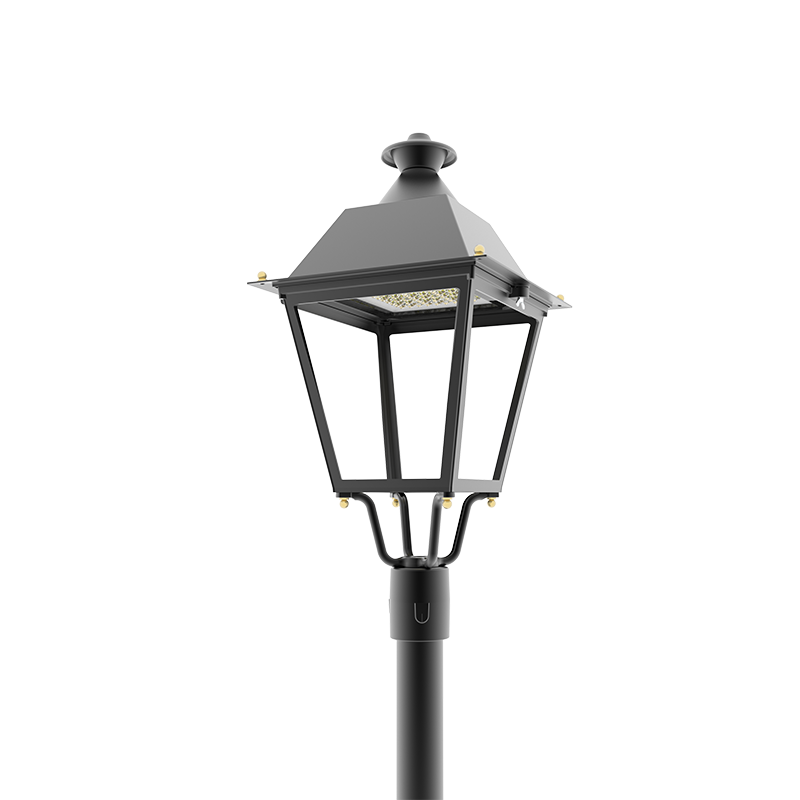
The European-style vintage lantern-style post-top light places a lantern body on a post. The listing describes a thickened die-cast aluminum frame with internal metal reinforcement, tempered glass on four sides and a hinged top that opens for service. It suits resorts, parks, residential communities and commercial districts where a classic look matters.
Garden bollard
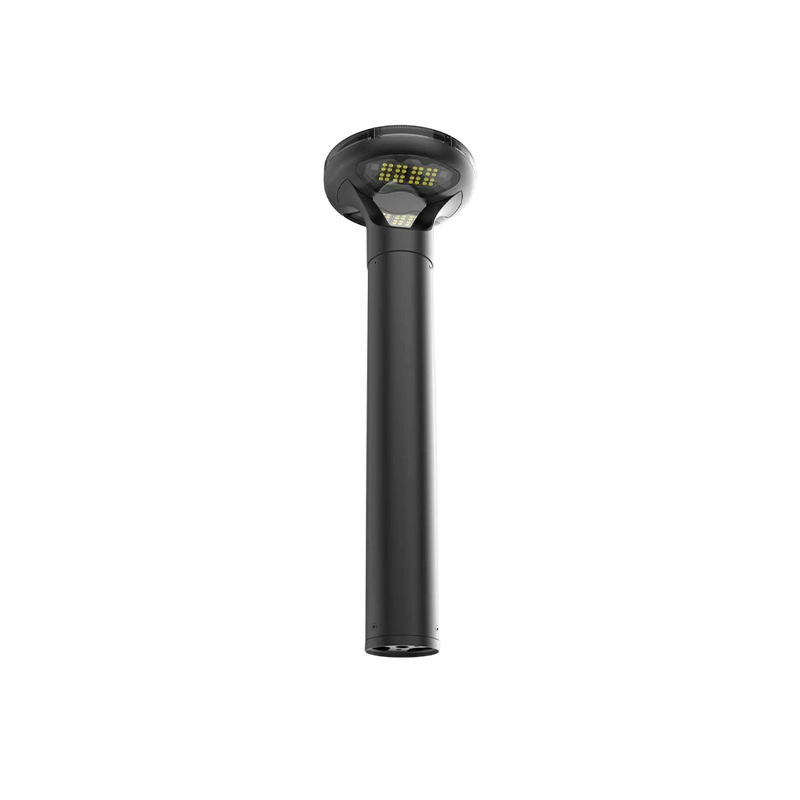
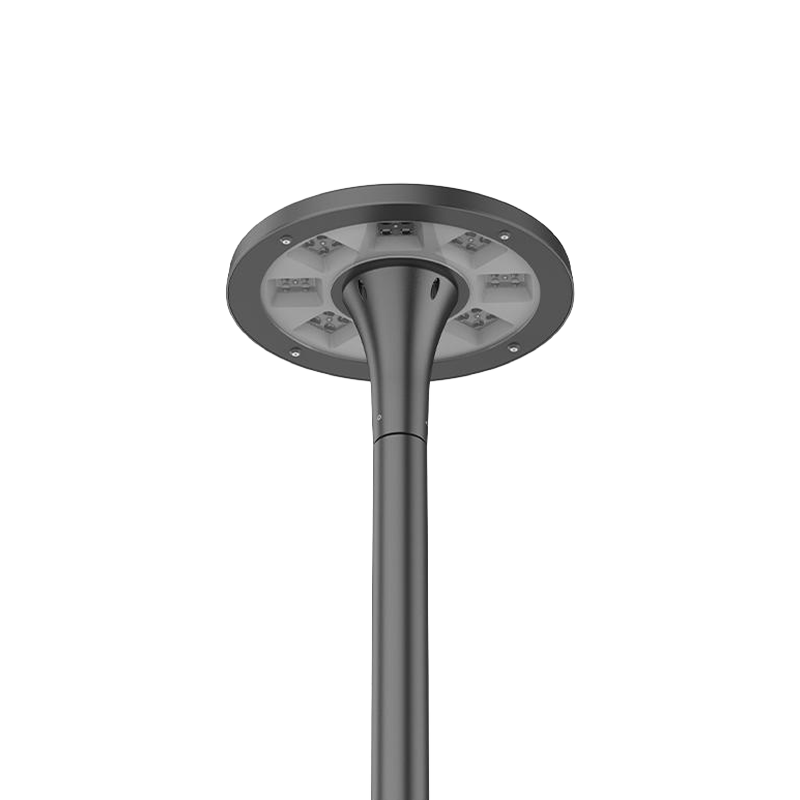
The UFO-style garden bollard light has a disc-shaped head with several LED modules arranged evenly behind a diffuser. The listing states uniform 360-degree illumination and suggests residential walkways, park greenbelts, campus plazas and business parks. A bollard marks the edge of a path clearly and stays below eye level, which helps in places where tall posts would feel out of scale.
Open-frame support light
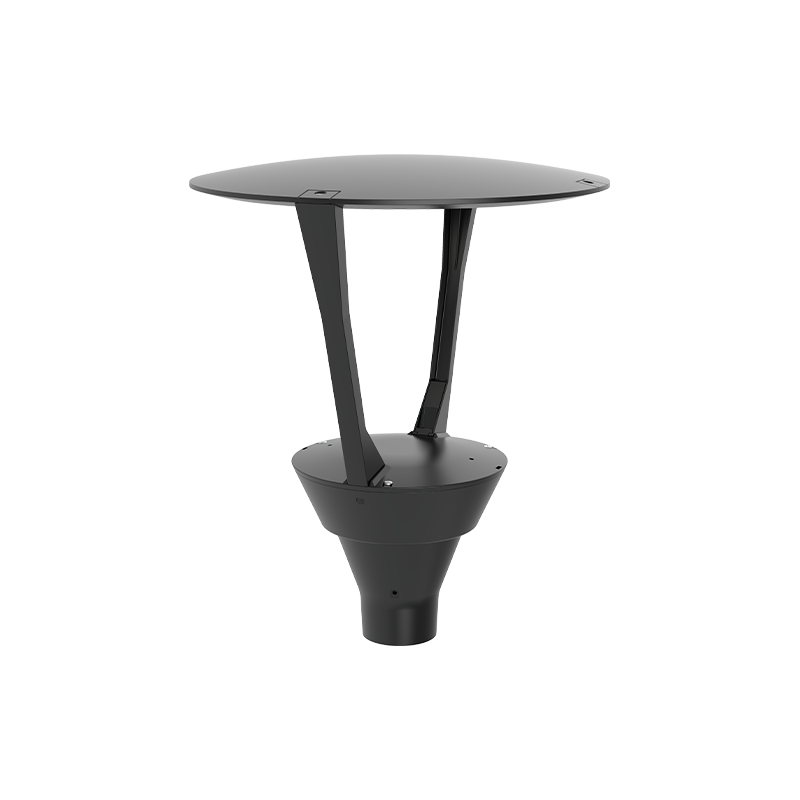
The modern three-prong support garden light uses an open support structure with a single-piece die-cast aluminum body. The listing says the open frame improves airflow and heat dissipation, and that a standardized mounting interface fits mainstream garden pole systems. It suits urban walkways, commercial plazas, industrial parks and hotel landscapes.
Style families
Across the range, Forland offers modern minimalist, classic European and antique-style lantern designs to match different architecture and planting schemes. A modern building with clean lines pairs well with a minimalist form. A heritage district or a resort in a traditional style often calls for a lantern.
Read the chart as a guide to roles. The lantern leads on decorative value and servicing access. The bollard leads on path marking and low profile. The open-frame pole top leads on coverage. Many projects mix two types, such as bollards along a narrow path and lanterns at the plaza.
Anatomy of a Garden Post Light
Knowing the parts helps when you read a data sheet or compare two offers. The isometric drawing shows a post-top lantern, the most common form of Landscape Post Lights, with its main parts labeled.
What each part does
- Die-cast aluminum frame: carries the glass and the light engine and resists corrosion when coated. The lantern listing states a thickened frame with an internal metal reinforcement system.
- Tempered glass or diffuser: protects the light source, spreads the light and controls glare. The lantern uses glass on four sides, and the bollard uses a high-transmittance diffuser.
- LED module and optics: turns electric power into light. Lenses or reflectors shape the beam so light lands on the path and not in the eyes of people walking by.
- Driver: converts supply power to the steady current the LEDs need. The lantern listing states a wide-voltage constant-current driver with several circuit protection systems.
- Post: sets the mounting height and carries the cable to the fixture.
- Base plate and anchors: hold the post upright and transfer wind load to the foundation.
Mounting Height and Spacing: How Much Light Reaches the Path
Two choices set the light on a path more than any other: how high the fixture sits and how far apart the posts stand. A taller post spreads light wider but lowers the peak under the fixture. Wider spacing leaves darker gaps between posts. The charts below use a simple model to show both effects.
Illuminance E = I x h / (h squared + x squared) to the power 1.5
I in candela, h is mounting height, x is distance from the pole
The model treats each fixture as an ideal downward hemisphere source with 1,000 lumens, so I equals 1000 divided by two pi, about 159 candela. It applies the inverse-square and cosine relations that appear in any lighting textbook. Real fixtures use optics that push light outward and flatten the central peak, so measured values differ. The model is meant to show trends.
Light on the ground at three mounting heights
At 2.5 meters the peak under the pole reaches about 25 lux in the model, while at 4 meters it falls to about 10 lux. Beyond 4 meters from the pole the three curves converge, which means a higher post trades peak brightness for a flatter, wider spread. For a path where people walk close to the post line, a lower mounting height gives brighter light under the fixture. For a wide plaza, a higher mounting height spreads light more evenly.
Light at the midpoint between two posts
The darkest point on a straight path sits halfway between two posts. The bar chart shows the model value at that midpoint for a 3 meter mounting height as spacing grows.
Reading the result: stretching the spacing from 6 meters to 14 meters cuts the midpoint value by roughly 80 percent in this model. A common starting point is a spacing of three to four times the mounting height, then a check against the photometric file of the chosen fixture. Lighting design guides, such as those published by the Illuminating Engineering Society, give target levels for walkways. Take the figure from the guide your project follows.
LED Light Source, Color Temperature and Glare Control
Outdoor Garden Post Lights live or die by how the light feels to a person walking underneath. Three properties matter most: color temperature, color rendering and glare.
Color temperature
Color temperature in kelvin describes how warm or cool the light looks. Warm white around 2700K to 3000K gives a soft, inviting tone that suits gardens, resorts and residential communities. Neutral white around 4000K looks crisper and suits plazas and business parks. The International Dark-Sky Association recommends warm-colored outdoor lighting at 3000K or lower to reduce sky glow and the effect on wildlife. The Forland listings state that various color temperature and wattage configurations are available, so the choice can match the setting.
Color rendering
The color rendering index (CRI) rates how faithfully a source shows colors compared with a reference. Planting, stone and facade colors look more natural under a higher rating. A CRI of 80 or more is commonly requested for landscape work. Ask for the rating on the data sheet, since it varies between LED modules.
Glare and uniformity
Glare comes from a bright source in the line of sight. Frosted glass, diffusers and lenses spread the source over a larger area. The lantern listing describes professional optical distribution with tempered glass on four sides to deliver soft, uniform light and minimize glare. The three-prong listing describes lenses that produce uniform floodlighting with reduced glare for pedestrian areas. Place posts so the lamp is above normal eye level where people approach, and avoid aiming bright optics toward windows.
Driver quality
A constant-current driver holds the LED current steady as the supply voltage shifts, which keeps brightness stable. A wide-voltage input range helps when supply conditions vary between sites. Circuit protection inside the driver guards against surges and overheating. Both points appear in the lantern listing and are worth asking about on every model.
Energy Use and Dimming for Outdoor Garden Post Lights
A post light runs on a fixed daily schedule, so its energy use follows from wattage and operating hours. The example below assumes a 20W fixture that runs 4,000 hours a year, which is about 11 hours each night. Dimming lowers the total without leaving paths dark.
Full output for 4,000 hours uses 80 kWh. Holding half the hours at 50 percent output drops that to 60 kWh, and holding half the hours at 30 percent drops it to 52 kWh. A flat 50 percent profile over the whole night uses 40 kWh. The right profile depends on how the space is used. A residential community path may dim after midnight. A hotel entrance may hold full output until the last guests arrive.
Controls to consider
- A photocell or time switch to set dusk and dawn operation.
- Stepped dimming programs built into the driver.
- Motion sensing where traffic is light at night, so the fixture rises to full output when someone approaches.
Materials, Coatings and Weather Protection
Garden fixtures sit in rain, sun, irrigation spray, dust and sometimes salt air. The Forland range is built from high-strength die-cast aluminum with an outdoor-grade finish. The lantern listing mentions a thickened frame, the UFO-style bollard listing mentions an electrostatic spray coating, and the three-prong listing mentions a matte powder-coated finish with resistance to UV radiation, acids, alkalis and corrosion.
What IP65 means
The IP code in IEC 60529 has two digits. The first digit rates protection against solid objects and dust. The second digit rates protection against water. The lantern and three-prong listings state an IP65 protection rating.
| Digit | Value | What it covers |
|---|---|---|
| First | 6 | Dust-tight, no dust entry |
| Second | 5 | Protected against low-pressure water jets from any direction |
That protection suits rain and irrigation spray. It does not cover submersion, so avoid placing a fixture where water can pool around its base.
Heat and airflow
LED life depends on temperature. The three-prong listing describes an open-frame design that promotes airflow and helps heat dissipation. A die-cast aluminum body also acts as a heat sink for the light engine. Fixtures installed in hot, humid or direct-sun locations benefit from these features.
Coastal and high-humidity sites
The lantern listing refers to long-term use in corrosive coastal environments. In salt air, ask about the coating system, the grade of fasteners and the gasket material, and plan to rinse the fixtures with fresh water as part of routine care.
Garden Post Lights From the Forland Range
The cards below show the three models on the Garden Post Lights category page. Each card lists data from the manufacturer's product page.
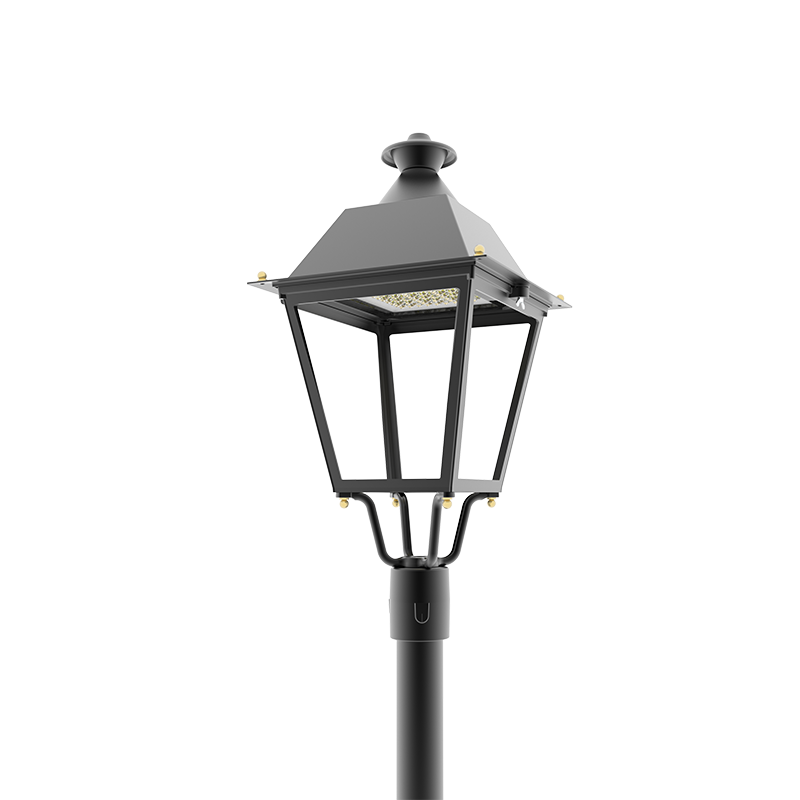
European-Style Vintage Lantern-Style Post-Top Light
- Thickened die-cast aluminum frame with metal reinforcement
- Hinged top for quick service access
- Tempered glass on four sides, IP65
- Wide-voltage constant-current driver
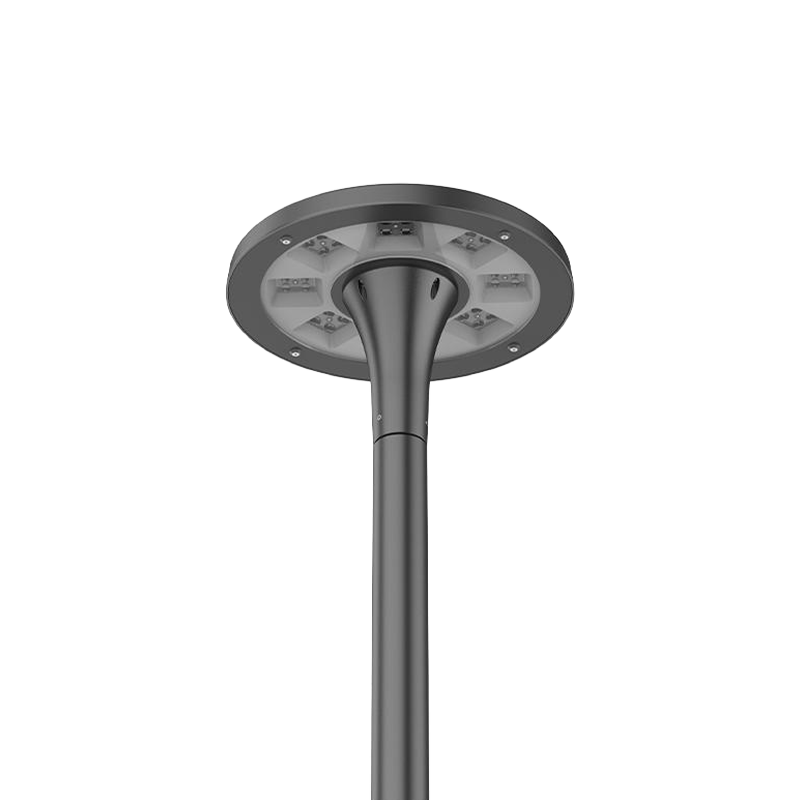
UFO-Style Garden Bollard Light
- Disc-shaped head with evenly arranged LED modules
- Uniform 360-degree illumination through a diffuser
- Die-cast aluminum housing, electrostatic spray coating
- Color temperature and wattage options
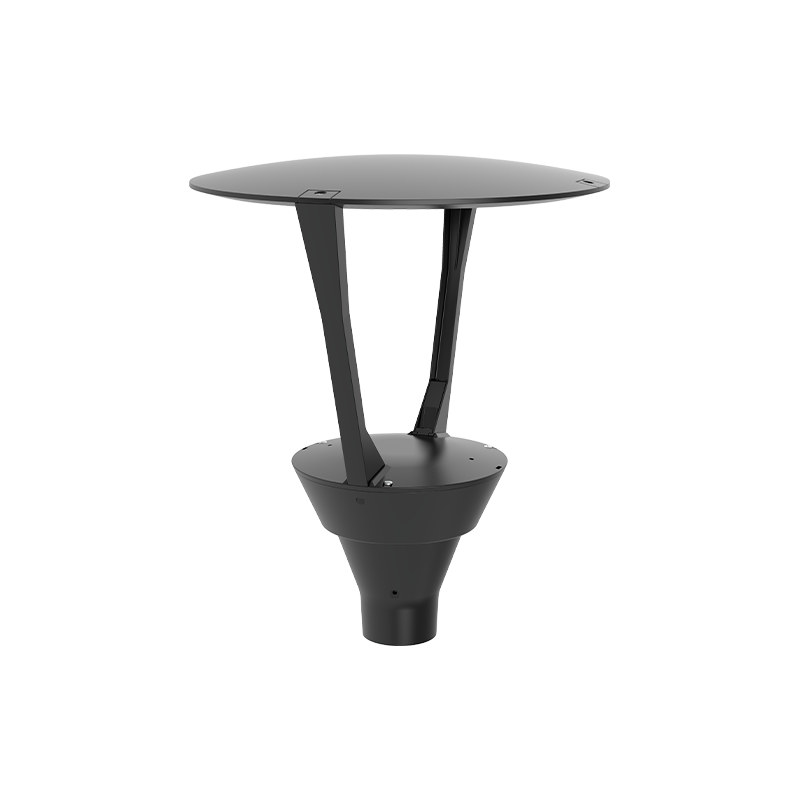
Modern Three-Prong Support Garden Light
- Single-piece die-cast aluminum body, matte powder coat
- Open frame for airflow and heat dissipation
- IP65, lenses for uniform, low-glare floodlighting
- Standardized mounting interface for mainstream garden poles
| Feature | Lantern | UFO bollard | Three-prong |
|---|---|---|---|
| Form | Post-top lantern | Low bollard | Open-frame pole top |
| Finish | Outdoor anti-corrosion coating | Electrostatic spray | Matte powder coat |
| IP rating on listing | IP65 | Not stated | IP65 |
| Light spread | Soft, uniform, four glass sides | 360-degree diffused | Uniform floodlighting |
| Typical sites | Resorts, parks, districts | Walkways, campuses | Plazas, hotel grounds |
Where Landscape Post Lights Fit Well
Garden Post Lights suit places where people walk at night and where the setting matters. The tiles list the settings named in the Forland product information and what to check in each.
Residential communities
Lights line the internal roads and shared paths. Choose a warm color temperature, keep glare low near windows and set a dimming profile for late hours.
Villa complexes
Gardens, entrance drives and courtyards benefit from lanterns with an architectural look. Match the finish color to gates, railings and facade tones.
Park walkways
Long straight paths need even spacing. Use the midpoint values in this guide to check dark gaps, and keep optics aimed toward the path and away from planting beds.
Resort hotels
Light is part of the guest experience. Lanterns and bollards in warm white create a calm evening mood, and a corrosion-resistant finish handles pool spray and coastal air.
Commercial landscape
Plazas, business parks and campus malls call for consistent style across many posts. Order a single finish and fixture shape for the whole area to keep the look uniform.
Urban walkways
Open-frame fixtures with a standardized mount fit pole systems already common in city streetscapes, which simplifies matching poles and fixtures.
How to Choose Garden Post Lights: A Three-Step Method
A clear order of decisions avoids rework. Start with the site, then the fixture, then the electrical side.
Site
- Path or plaza width
- Nearby windows and trees
- Coastal, humid or dusty air
- Foot traffic after midnight
Fixture
- Form: lantern, bollard or open frame
- Mounting height and spacing
- Color temperature and CRI
- Finish color
Power
- Supply voltage range
- Wattage and driver type
- Dimming and control method
- Cable routing and feed points
Selection checklist
- Define the lit area and the target light level from the design guide your project follows.
- Pick the form that fits the scale of the space and the mood of the architecture.
- Set mounting height and spacing, then check the midpoint between posts with the photometric file.
- Choose color temperature and color rendering to suit planting and facade materials.
- Confirm the protection rating, coating and fastener grade for the local climate.
- Check the mounting interface against the pole or base that will carry the fixture.
- Review service access, such as a hinged top, so maintenance does not need special tools.
- List the custom items you need, such as pole height, shape, power, color temperature and finish.
Installation Planning and Maintenance Routine
Garden Post Lights are simple to run once installed, and most trouble traces back to planning. The Forland range uses a modular design that reduces on-site work, and the three-prong model uses a standardized mounting interface. Still, a few points deserve attention before the crew arrives.
Installation sequence
- Mark post positions on the plan and check spacing against the chosen mounting height.
- Prepare foundations and conduits, leaving a drip-free route for the cable into each post.
- Set the base plate on anchor bolts and level the post.
- Fit the luminaire to the mounting interface and connect the supply cable.
- Close and seal the housing, and test operation at dusk to check the light pattern.
Suggested upkeep schedule
| Task | Interval | What to look for |
|---|---|---|
| Night walk-through | Monthly | Dark or flickering fixtures |
| Clean glass and diffusers | Quarterly | Dust, insects, spray marks |
| Check fasteners and base | Twice a year | Loose bolts, tilt, rust |
| Inspect seals and gaskets | Yearly | Cracks, hardening, moisture |
| Coating check | Yearly | Chips, fading, salt film |
A hinged top, as on the lantern listing, shortens service visits because the technician opens the head without removing it. Clean glass with a soft cloth and mild detergent, then rinse with clean water.
Working With a Garden Post Lights Manufacturer for Custom Landscape Post Lights
Founded in 2008 and based in Ninghai, Ningbo, Zhejiang, China, Forland positions itself as a professional Garden Post Lights manufacturer and custom Landscape Post Lights factory. The company reports more than 18 years in the lighting industry and focuses on research, design and production of full-series LED lighting products. Its factory runs die-casting machines, CNC machines, punching machines and automatic spraying and assembly lines, so housings, coatings and assembly are handled in-house from raw material to finished product.
What can be customized
The manufacturer lists pole height, luminaire shape, power configuration, color temperature and finish color as customizable. Project support covers tailored landscape lighting solutions. For a community or resort with many posts, these options let a designer keep one visual language across the whole site.
| Item to send | Why it helps |
|---|---|
| Site plan and path widths | Sets spacing and height |
| Preferred style or reference photo | Guides the fixture shape |
| Supply voltage and control method | Matches the driver |
| Color temperature and finish color | Fixes the look |
| Climate and coastal exposure | Guides coating and hardware |
| Quantity and delivery site | Plans production and shipping |
Common Mistakes When Specifying Garden Post Lights
These errors show up often on landscape projects and are simple to avoid with a short review.
Spacing posts too far apart
Dark gaps appear between fixtures. Use the midpoint check and the photometric file before fixing positions.
Choosing cool white for a garden
Cool light can feel harsh among plants and stone. Warm white at 3000K or lower is the usual starting point.
Ignoring glare near windows
A bright lamp in the line of sight is uncomfortable. Choose diffusers or lenses and aim the optics away from homes.
Overlooking service access
A fixture that needs full removal for a driver swap slows maintenance. A hinged top makes routine visits shorter.
Skipping the climate check
Salt air, heat and humidity attack coatings and fasteners. Confirm the finish and hardware for the site.
Mixing styles without a plan
Several unrelated shapes in one space look scattered. Fix a style family and vary only height or form by role.
Sources and Method Notes
- Product details: Forland Garden Post Lights category page and model pages on forlandlighting.com.
- Color temperature guidance: International Dark-Sky Association recommendation for warm-colored outdoor lighting at 3000K or lower.
- IP code digits: IEC 60529, degrees of protection provided by enclosures.
- Illuminance model: inverse-square and cosine relations for a point source, calculated by the author.
- Energy example: arithmetic on assumed wattage and operating hours.
- Radar scores: author's planning assessments, not measurements.
Garden Post Lights FAQ
Q1. What are garden post lights?
They are outdoor luminaires mounted on a post or base to light paths, courtyards, plazas and planted areas at pedestrian scale, while adding to the look of the landscape.
Q2. What is the difference between garden post lights and bollard lights?
A post light carries its luminaire higher and covers a wider area. A bollard stands low, often around knee to waist height, and marks the path edge.
Q3. What height should outdoor garden post lights be?
Post-top fixtures on pedestrian paths commonly sit at about 2.5 to 4 meters. Choose the height with spacing and glare in mind, and check against the fixture photometric file.
Q4. How far apart should landscape post lights be?
A common starting point is three to four times the mounting height. Then check the midpoint between posts, which is the darkest spot on the path.
Q5. What color temperature suits garden post lights?
Warm white at 2700K to 3000K suits most gardens and resorts. The International Dark-Sky Association recommends 3000K or lower for outdoor lighting.
Q6. What does IP65 mean on a garden light?
The 6 means dust-tight and the 5 means protected against low-pressure water jets. It suits rain and sprinkler spray but not submersion.
Q7. Can garden post lights be used near the coast?
The lantern listing refers to corrosive coastal use. Confirm the coating system and fastener grade, and rinse the fixtures with fresh water as part of routine care.
Q8. Can I customize landscape post lights?
Forland lists pole height, luminaire shape, power configuration, color temperature and finish color as customizable, with project support for landscape lighting plans.
Q9. How are garden post lights serviced?
The lantern has a hinged top for quick access. For other models, ask how the driver and light engine are reached, and wipe the glass with a soft cloth during checks.
Q10. Do garden post lights need dimming or sensors?
They are optional. In the 20W example, dimming to 50 percent for half the night cuts yearly energy from 80 kWh to 60 kWh while keeping paths lit.