Español



A driveway that reads clearly at nine in the evening and a border that turns into a black wall are often the same plants, the same stone, and the same budget. The difference is the lighting scheme. When buyers ask about landscape lighting benefits, they expect an answer about appearance, but the practical answer covers four things at once: how safely people move after dark, how much of the property stays visible to its owners and neighbours, how the garden reads at night, and what the system costs to run and maintain.
None of those benefits is automatic. A fixture mounted 300 mm too low, aimed at eye level, or rated IP44 in a wet border will deliver glare, callbacks and a maintenance list. The benefit comes from specification, not from the mere presence of fixtures. The sections below take each benefit in turn and show which measurable details—beam angle, correlated colour temperature, ingress protection, mounting height, control gear—decide whether it actually appears on site.
Content
- 1 The Four Benefits That Hold Up Under Scrutiny
- 2 Safety and Wayfinding: The Benefit Buyers Underestimate
- 3 Security: Visibility Matters More Than Brightness
- 4 Depth, Character and Curb Appeal
- 5 Running Cost, Maintenance and Lifecycle
- 6 What to Put in the Specification
- 7 Frequently Asked Questions
- 7.1 Q1. What are the main benefits of landscape lighting?
- 7.2 Q2. Does landscape lighting really improve security?
- 7.3 Q3. What colour temperature should path lighting be?
- 7.4 Q4. What IP rating do garden and path lights need?
- 7.5 Q5. Is solar lighting reliable in cloudy climates?
- 7.6 Q6. How do I compare landscape lighting manufacturers?
The Four Benefits That Hold Up Under Scrutiny
Most proposals list a dozen advantages. In practice, almost all of them reduce to four outcomes that a client can verify after installation:
- Safe circulation. Steps, level changes, driveway edges and pool surrounds stay legible after dark, so residents and guests move without hesitation.
- Visibility and deterrence. Doors, side gates and blind corners remain observable from the house or from the street, which is what discourages opportunistic intrusion.
- Depth and curb appeal. Trees, walls and planting read as separate planes instead of a flat silhouette, and the elevation keeps its character at night.
- Predictable running cost. Energy use, lamp replacement and water ingress are controlled by design decisions rather than luck.
If a fixture schedule cannot be tied back to one of these four, it is decoration rather than specification.
Safety and Wayfinding: The Benefit Buyers Underestimate
Trips and falls happen where the eye cannot read a change in level. The lighting task is therefore to describe the walking surface, not to illuminate the view. A path light aimed across the path at knee height and shielded above horizontal does this well; the same fixture tilted upward throws light into faces, contracts the pupil, and makes the ground harder to read even though the scene measures brighter.
Most of the numbers here come from design practice rather than regulation. Bollards for residential paths are commonly set at 600–900 mm, with spacing around two to three times the mounting height so that adjacent pools of light overlap. That figure is a starting point, not a rule—confirm it against a photometric layout for the actual fixture rather than a catalogue claim. For exposed garden positions, IP65 is the sensible minimum, IP66 where pressure washing is routine, and IK08 helps in semi-public areas where strimmers and trolleys make contact.
| Goal | Specification that delivers it | What fails when it is skipped |
|---|---|---|
| Safe walking on paths and steps | Bollards or low post-tops at 600–900 mm, overlapping beams, 2700–3000 K, CRI 80 or higher | Dark gaps between pools of light; a step edge disappears |
| Glare-free accent on trees and walls | 10–15° beam for trunks, 25–40° for shrubs, visors or louvers, aim below horizontal | Light in the eye, lost detail, complaints from neighbours |
| Reliable performance in wet borders | IP65 minimum, IP66 for washed areas, silicone gaskets, corrosion-resistant die-cast body | Water ingress, fogged lenses, driver failure in the first season |
| Consistent colour across a scheme | One CCT family for all fixtures, binned LEDs, matching finish codes | Visible warm-to-cool mismatch on the same elevation |
Security: Visibility Matters More Than Brightness
Over-lighting a façade is a common mistake. Excessive brightness creates hard shadows behind shrubs and glare on glazing, so a camera or a neighbour sees less, not more. Uniform, moderate illuminance across doorways, side passages and rear gates does more for security than a single intense floodlight. A 3000 K white is usually enough to identify faces and vehicle colours without turning the garden into a car park.
Controls make the difference between a deterrent and an annoyance. A photocell with an astronomical time switch keeps the scheme running only when it is dark, and a passive infrared sensor on a side path gives full output when someone approaches. Full cut-off optics that throw no light above the horizontal also reduce skyglow, which matters increasingly in residential planning discussions.
Depth, Character and Curb Appeal
Layering is what separates a designed garden from a lit one. Three layers do most of the work: low path light for function, narrow accent light for trunks and architectural detail, and an ambient layer from post-top fixtures at entrances and driveway junctions. Contrast between layers should be noticeable but restrained—if the accent is ten times brighter than the path, the eye adapts to the accent and the path goes dark.
Beam angle is the cheapest way to control this. A 10–15° optic grazes a trunk and reaches the canopy without spilling onto the lawn; 25–40° suits shrubs, low walls and gates; a 60° or wider flood washes a surface but rarely flatters it. Colour consistency counts as much as intensity—two fixtures of nominally the same colour temperature from different production bins can read visibly different on the same wall. Buying the whole scheme from one manufacturer, with a stated binning tolerance, avoids that argument.
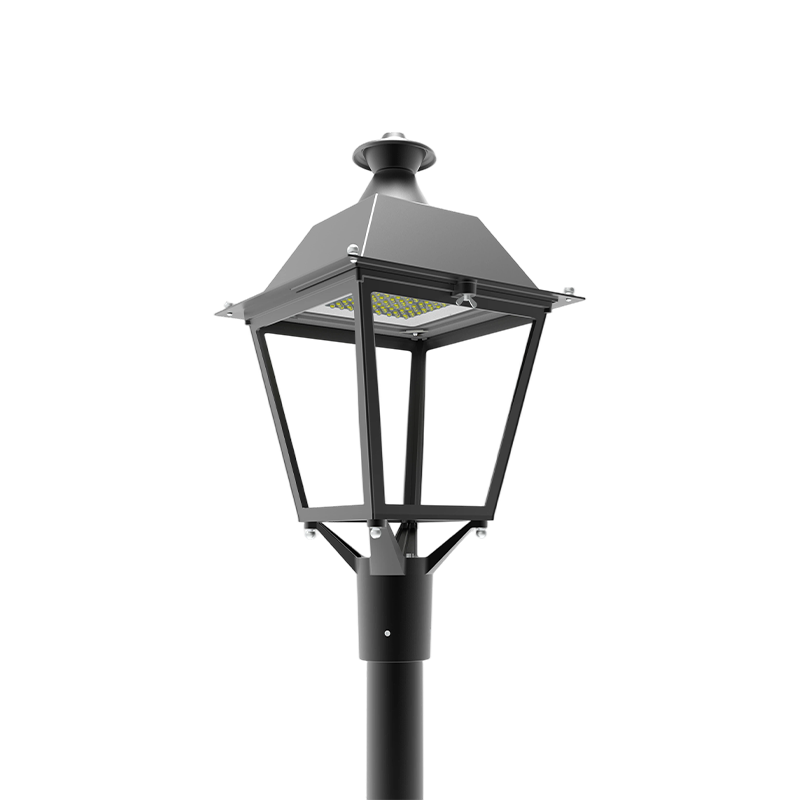 Vintage Lantern-Style LED Post-Top LightA classic lantern post-top with die-cast aluminum, IP65 protection, tempered glass and top access, suited to entrances and driveways where optics and finish consistency matter.View Product →
Post-top fixtures carry the entrance and driveway layer, and their optics matter as much as their shape; the guide to what garden post lights are and where they fit covers mounting heights and typical applications in more detail.
Running Cost, Maintenance and Lifecycle
LED sources have shifted the cost argument, but the driver and the thermal path now decide longevity. A die-cast aluminium body with a properly sized heat sink keeps junction temperature down; a powder-coated finish with stainless fasteners resists the corrosion that ruins coastal installations; a replaceable driver turns a failed unit into a service visit rather than a replacement. Ask for the driver brand, the surge protection rating and the IP test report, not just the lumen figure on the box.
Solar fixtures remove trenching and mains connection, which is often the largest line in a garden lighting budget, but they trade that saving for battery sizing. In northern European or Canadian winters, a panel rated for summer performance may not recover enough charge for a full night, so autonomy needs to be specified for the worst month rather than the best. Shading from mature trees is the other limiting factor, and it should be assessed before the layout is fixed rather than after.
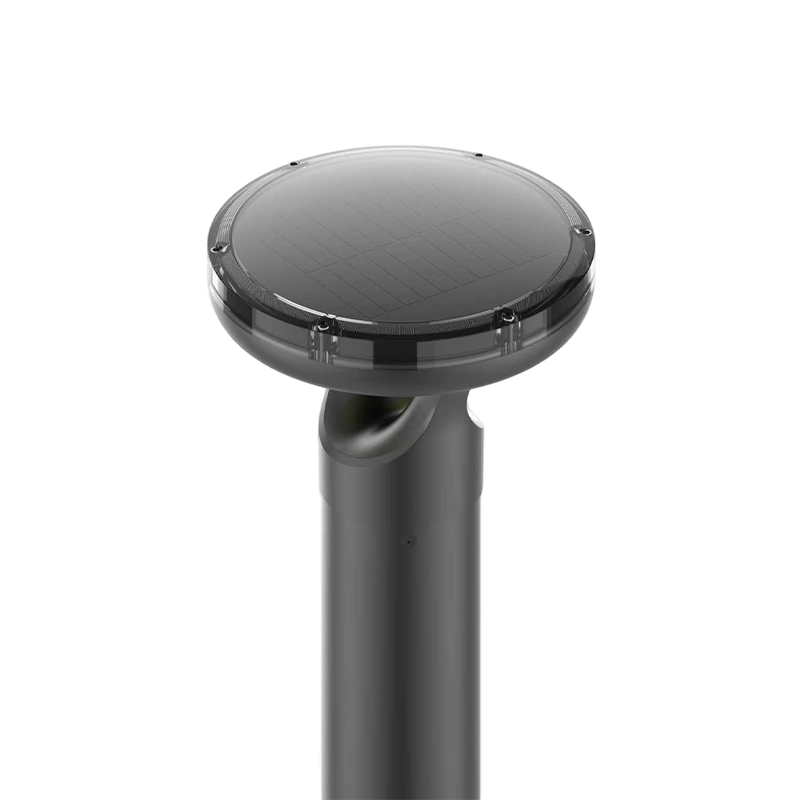 All-in-One Solar LED Garden Pathway LightAn all-in-one solar pathway light with motion sensing and adjustable CCT, useful where trenching is impractical but layout must account for winter charging and shade.View Product →
Where mains power is unavailable or trenching is impractical, solar bollard and pathway lights with a separate panel and an MPPT controller usually outperform all-in-one units that sit in shade for part of the day.
Illustrative diagram — not to scale. Two mounting heights create overlapping layers on the same walkway.
What to Put in the Specification
Whether the buyer is a homeowner with a landscaper or a distributor assembling a container load, the same six items decide the result:
- Ingress protection and impact rating appropriate to the position, including coastal corrosion exposure.
- Colour temperature and CRI held to one value across the whole scheme, with binning tolerance stated.
- Beam angle and shielding matched to what each layer is meant to do.
- Construction detail: die-cast body, coating thickness, gasket material, replaceable driver.
- Control strategy: photocell, timer, sensor, or solar autonomy for the worst month.
- Spares and serviceability, including lens and driver availability two or three seasons later.
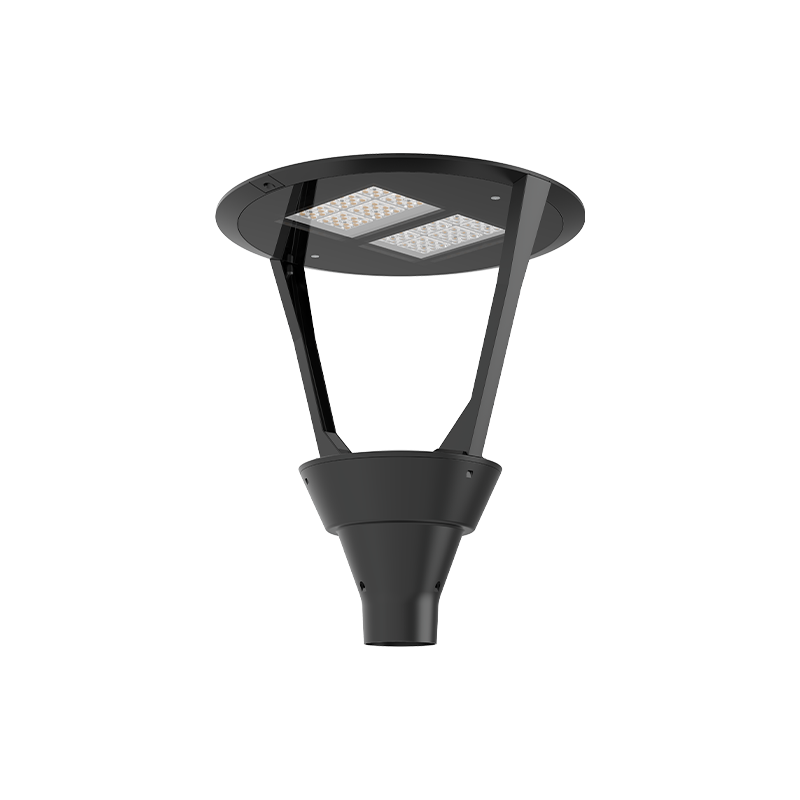 Modern Three-Prong Support LED Garden LightA minimalist die-cast aluminum garden fixture with open-frame heat dissipation and IP65 protection, relevant when comparing construction, finish and batch consistency across suppliers.View Product →
For importers and project buyers, it also helps to know how the fixture is made. A manufacturer that runs its own die casting, CNC machining, powder coating and assembly under one roof controls the variables that cause mismatch between batches—wall thickness, coating thickness, colour consistency and torque on gasketed joints. Forland has operated in Ninghai, Zhejiang since 2008, works to ISO 9001, and holds GS, TUV, SEMKO, FIMKO, CE and SAA certifications, with OEM and ODM work forming a large part of its garden, path and street lighting output.
Frequently Asked Questions
Q1. What are the main benefits of landscape lighting?
Safer movement around steps and paths, better visibility of entrances and blind spots, stronger depth and curb appeal at night, and a lower maintenance burden than most owners expect. Each depends on correct fixture selection and aiming.
Q2. Does landscape lighting really improve security?
Moderate, even light on doors, side gates and rear boundaries helps, especially with sensors or timers. Excessive brightness is counterproductive because glare creates shadows where people can approach unseen.
Q3. What colour temperature should path lighting be?
2700–3000 K with CRI 80 or above is the usual choice for gardens and residential paths. Keep one colour temperature across the scheme to avoid visible mismatch between fixtures.
Q4. What IP rating do garden and path lights need?
IP65 is a practical minimum for exposed positions. Specify IP66 where jets of water are used for cleaning, and add an impact rating such as IK08 in areas where equipment or trolleys may strike the fixture.
Q5. Is solar lighting reliable in cloudy climates?
It can be, if the panel and battery are sized for the least sunny month rather than peak summer. Shading from trees, panel orientation and battery chemistry all matter, so autonomy should be confirmed in writing.
Q6. How do I compare landscape lighting manufacturers?
Compare in-house process control, certification scope, LED and driver provenance, binning tolerance, spare-part availability and sample consistency. Price alone rarely reflects the cost of callbacks after the first wet season.
If you are specifying a garden, path or entrance lighting programme and want to discuss mounting heights, optics, finishes or custom manufacturing, send the layout and target specifications to the Forland team for a technical review and quotation.